
The Nature, Power, and Limits of Systems#
To do more than one person can do alone, people create systems.
A system turns resources into power#
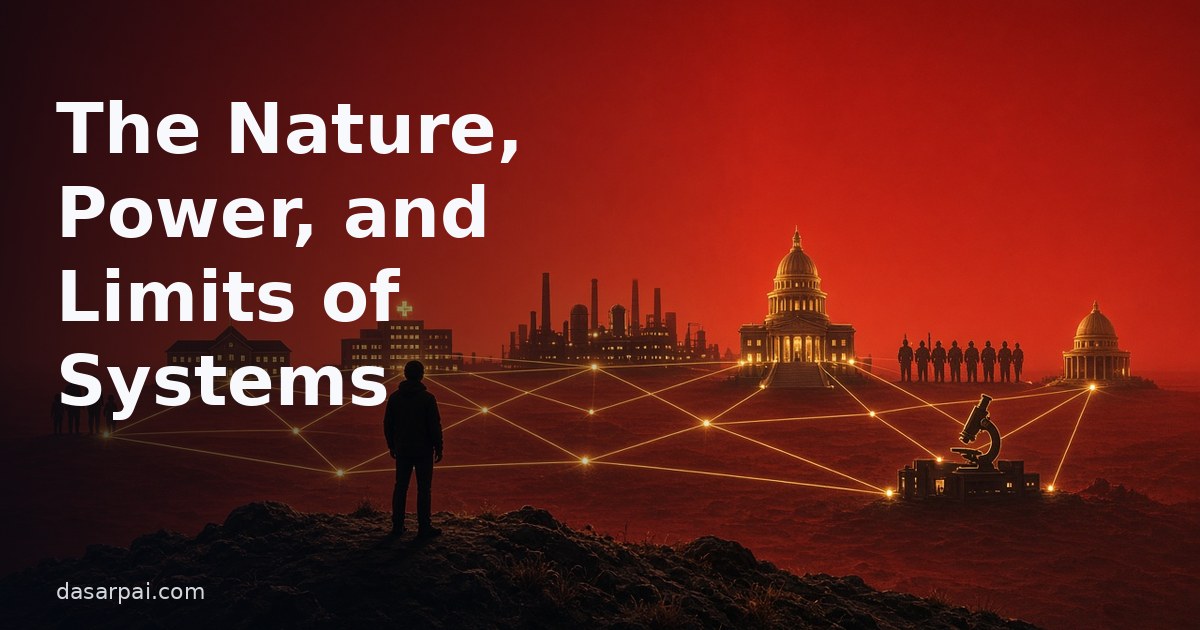
A family, company, political party, government, military, religious organization, university, hospital, cooperative, social movement, or village community can all become a system. Each system gathers resources: money, people, knowledge, land, technology, authority, reputation, infrastructure, relationships, and experience.
A system does more than collect those resources. It changes them into new resources and into power.
Money can become profit and investment. Land, labor, knowledge, and capital can become schools, hospitals, factories, roads, universities, and communication networks. Knowledge produces more knowledge. Education produces skilled people. A hospital creates medical skill. A military system turns training, technology, organization, and resources into defense capability. A democratic system turns citizens, laws, taxation, debate, and administration into governance.
A system is not only a container of resources. It is a machine that turns resources into new capabilities.
The better a system organizes and converts its resources, the more power it gains. Power is the ability to change what happens in the world. That change is not automatically good or bad.
Power always serves some purpose#
Power may be used to reduce poverty, disease, corruption, crime, violence, or environmental destruction. It may also be used to spread an ideology, a religion, an economic model, a political philosophy, a cultural value, or a way of life.
So we must ask two questions. How much power does the system have? What purpose does that power serve?
Every system has interests. Some are stated openly: profit, education, national security, justice, equality, spiritual growth, scientific progress, or social welfare. Over time, an established system grows another interest: its own survival.
It begins to protect its original purpose, and also its authority, resources, reputation, structure, and influence. Sometimes the interests of the system and the people inside it stay aligned. Sometimes they do not.
When the means becomes the purpose#
Many systems begin with a clear purpose and a small group of people deeply committed to it. Religious traditions, philosophical schools, social movements, political organizations, educational institutions, and scientific communities often begin this way. Buddhism, Christianity, Islam, Sikhism, and the many philosophical and devotional traditions within Hinduism all built communities and institutions around teachings, practices, or shared purposes. As generations pass, the original movement also acquires buildings, property, leadership structures, rituals, offices, followers, traditions, symbols, and social identity.
At that stage another possibility appears: keeping the group/community can become more important than asking whether the community still serves its original purpose. Membership can turn into identity, identity into loyalty, and loyalty into a tribal instinct of us and them. A person may then feel required to defend the institution simply because it is “ours,” even when some of its practices need reflection or reform.
This tendency is not unique to religion. A political party created to advance certain principles may later care mainly about winning elections and keeping its organization. A university created for learning and inquiry may become busy with rankings, funding, bureaucracy, or institutional reputation. A charity may give more and more attention to fundraising and organizational survival, and less to the people it was created to serve. Even scientific communities can grow attached to an established way of thinking and at first resist ideas that challenge the frame in which their institutions and careers grew. Scholars of organizations name related patterns goal displacement (the official goal shifts toward keeping the organization alive), mission drift (the daily work slowly leaves the original mission), and, in political organizations, the tendency toward oligarchy (rule by a small group at the top).
Organization itself is not the problem. Without organization, the original purpose may not last even one generation. The paradox is that the organization created to preserve a purpose can become something that must itself be preserved, sometimes at the cost of that purpose.
The individual and the collective#
Systems also differ in how they balance the person and the group.
An individual-oriented system stresses personal freedom, property, prosperity, and ambition. It assumes that when individuals succeed, society may gain from their creativity, investment, and innovation.
A collectivist system puts more weight on shared responsibility and on shared institutions such as public education, healthcare, welfare, and infrastructure. A military system may take this further. It may expect people to put personal comfort, choice, and even life below the mission or the country.
A religious order may ask people to give up wealth or ambition for spiritual discipline. A family may ask parents to sacrifice for their children, and later ask children to care for aging parents. A corporation may encourage personal ambition, then point that ambition toward the organization’s survival and profit. A cooperative tries to join personal participation with shared ownership. A humanitarian organization asks people to give time, money, and comfort for the benefit of others. A scientific community values one person’s discovery, but knowledge becomes powerful because researchers share it, criticize it, repeat it, and build on one another’s work.
Every system must answer one question: how much should a person live for themselves, and how much should they live for the larger group?
Different systems answer this question differently. Each answer creates strengths and weaknesses.
A strength often carries its weakness#
The military values discipline, hierarchy, obedience, coordination, and a single chain of command. These qualities work well in war or crisis. Too much central control can suppress independent thinking and local flexibility.
Democracy values participation, debate, representation, and individual rights. These qualities spread power and let competing views exist together. They can also make decisions slow.
A centralized political system may act quickly and gather resources efficiently. Concentrated power can weaken criticism and independent checks.
A market-oriented economy can encourage competition, innovation, and efficiency. It may also produce inequality and too much economic concentration. A welfare-oriented system can provide security and shared support. It needs taxation, administration, and hard choices about how to share resources.
Tradition can give continuity and identity, and it may resist needed change. Freedom can encourage creativity, and unlimited freedom may weaken coordination. Discipline creates reliability, and too much discipline can suppress initiative. Competition can produce excellence, and too much competition can destroy cooperation. Cooperation creates security, and too much dependence on the group can weaken personal responsibility.
This is a central principle: the strength of a system often contains the seed of its weakness.
Centralization creates speed, and dependence on the center. Decentralization creates flexibility, and it may produce fragmentation. Strong traditions create stability, and they can resist change. Innovation creates adaptability, and it can undermine continuity. Loyalty creates unity, and blind loyalty can suppress truth.
No system is perfect. Every system must balance the person and the group, freedom and discipline, stability and change, centralization and decentralization, competition and cooperation, short-term survival and long-term purpose, openness and control, efficiency and participation.
A healthy system keeps correcting itself#
A healthy system sees these tensions and keeps correcting itself. An unhealthy system assumes that its strengths have no limits and that its weaknesses do not exist.
Systems are born. They organize resources, create new resources, gather power, develop values, protect their interests, and face inner contradictions. They may adapt, transform, divide, decline, or disappear.
The useful wisdom is not a search for a perfect system. It is this: every system has a nature. That nature produces both strength and weakness. A system must stay awake enough to stop its strengths from becoming the cause of its destruction.
Hari Om Tat Sat
Yours Truly Hari
Hashtags#
#Systems #Power #Institutions #GoalDisplacement #MissionDrift #Organization #IndividualAndCollective #SelfCorrection #Society #Philosophy #Wisdom #LimitsOfPower
Comments: