
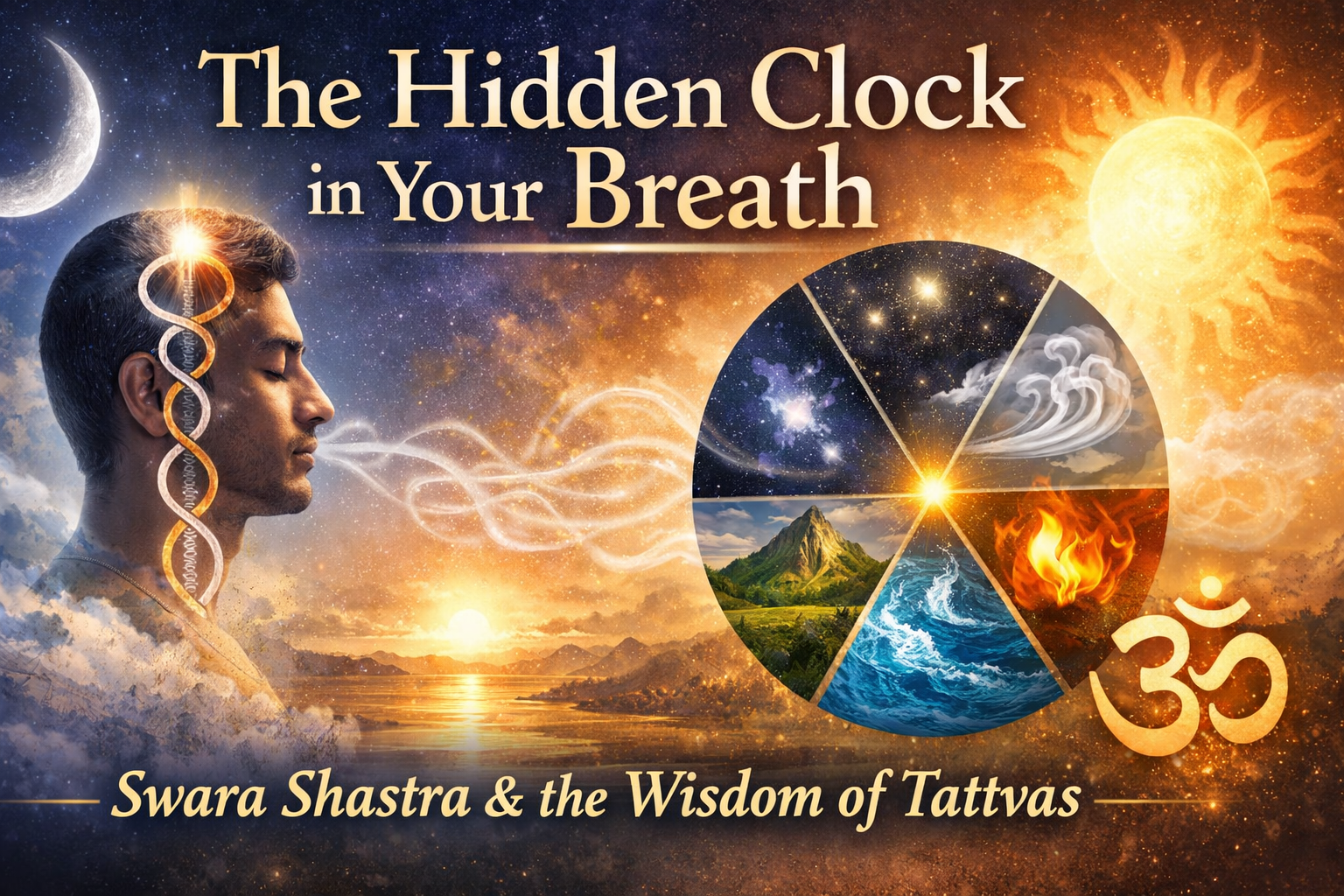
The Hidden Clock in Your Breath#
How Swara Shastra links nostrils, moon phases, sunrise, and right action#
Most of us think breathing is just a physical process. Air goes in, air goes out, and life continues.
But the tradition of Swara Shastra, especially as presented through Shiva Swarodaya (the foundational dialogue between Shiva and Parvati), asks us to look at breath differently. It says breath is not only a biological act. It is also a rhythm, a signal, and a guide. The flow of breath through the nostrils is linked with time, action, inner state, sunrise, and even the waxing and waning phases of the moon.
At the simplest level, Swara teaching begins with a very practical observation: at any given time, one nostril is usually more active than the other. When the left nostril is dominant, it is associated with Ida or Chandra swara (lunar, receptive). When the right nostril is dominant, it is associated with Pingala or Surya swara (solar, active). When both flow together in balance, that is linked with Sushumna, which traditional texts treat as a special state, more suitable for inner practice than ordinary worldly activity.
Ida, Pingala, and the quality of action#
Swara tradition does not treat every moment as equal. It says that the active nostril changes the quality of the time.
When Ida is flowing, the time is considered gentler, more receptive, more suitable for calm and harmonious actions. When Pingala is flowing, the time is considered more active, forceful, and fit for demanding or assertive work. When Sushumna is active, worldly action is generally discouraged, while meditation, mantra, prayer, and inner stillness are encouraged.
A traditional practical summary would be:
- Under Ida, one may favor peaceful, relational, receptive, or auspicious activities.
- Under Pingala, one may favor effortful, technical, forceful, administrative, or demanding activities.
- Under Sushumna, one should prefer spiritual practice over worldly engagement.
Ida–Pingala and Brain Hemisphere Connection#
In Swara Yoga and Hatha Yoga traditions, there is a well-recognized correlation between the nostrils/nadis and brain hemispheres:
- Ida (left nostril) is linked to the right brain hemisphere — associated with creativity, intuition, imagination, holistic thinking, emotions, and artistic expression.
- Pingala (right nostril) is linked to the left brain hemisphere — associated with logic, analytical thinking, language, planning, sequential processing, and rational decision-making.
This connection is implied in classical descriptions (Ida more mental/intuitive, Pingala more vital/structured) and is supported by modern yoga research. It makes Swara practice a practical tool for consciously shifting between creative and logical states.
The breath is also linked with the moon#
One of the most fascinating teachings of Swara Shastra is that breath is linked to the lunar fortnight, the tithi, and especially the moment of sunrise.
Shiva Swarodaya (verses 62–65) states that at sunrise, the active nostril should align with the lunar date. In Shukla Paksha (the bright fortnight), Ida is prescribed at sunrise on tithis 1–3, 7–9, and 13–15. On 4–6 and 10–12, Pingala should flow. In Krishna Paksha (the dark fortnight), this pattern reverses.
That means the traditional pattern is:
Shukla Paksha#
- Ida at sunrise on: 1, 2, 3, 7, 8, 9, 13, 14, 15
- Pingala at sunrise on: 4, 5, 6, 10, 11, 12
Krishna Paksha#
- Pingala at sunrise on: 1, 2, 3, 7, 8, 9, 13, 14, 15
- Ida at sunrise on: 4, 5, 6, 10, 11, 12
Why sunrise matters so much#
Swara tradition gives great importance to sunrise because it is treated as a daily reset point. It is the moment when one checks whether the inner rhythm and cosmic rhythm are aligned. If the wrong swara is flowing at the beginning of the day, traditional sources advise caution with major auspicious actions.
This makes sunrise a diagnostic moment. Before getting out of bed, one may first observe the breath through simple awareness.
The five tattvas in Swara practice#
Swara teaching also connects breath with the five tattvas: Akasha (ether), Vayu (air), Agni (fire), Jala/Apas (water), and Prithvi (earth). In the wider cosmological sense, this is the order of manifestation from subtle to gross: Akasha → Vayu → Agni → Jala → Prithvi.
In actual nostril practice (the operational swara cycle), the tattvas appear in this experiential sequence while one nostril dominates for approximately 60 minutes (2.5 ghatis).
Shiva Swarodaya (verses 71–72) states:
- During the flow of the swara, first the air element is active, then fire, then earth, water and ether.
- During the period of two and a half ghatis (i.e. one hour), the five elements are active in this order. The elements arise separately in the flow of each nadi.
The authoritative operational order is therefore:
Vayu → Agni → Prithvi → Jala → Akasha
Authoritative Tattva Table (per Shiva Swarodaya)#
Verse 158 gives the angula lengths, which align with the classical durations:
| Tattva | Duration (minutes) | Angula Length | Key Qualities for Identification |
|---|---|---|---|
| Vayu (Air) | 8 | 8 angula | Oblique/lateral flow, temperate, sour taste, dark color, mobile |
| Agni (Fire) | 4 | 4 angula | Upward/circular, hot, pungent/bitter, red color, sharp |
| Prithvi (Earth) | 12 | 12 angula | Central/steady, sweet taste, yellow, heavy/stable |
| Jala (Water) | 16 | 16 angula | Downward/flowing, cool, astringent, white/silver, fluid |
| Akasha (Ether) | 20 | Subtle / imperceptible | Diffused/all directions, bitter/void-like, spacious |
What to do and what not to do under each tattva#
1. Akasha tattva#
Do: meditation, japa, silence, prayer, subtle reflection.
Do not: begin major worldly, financial, or practical actions.
2. Vayu tattva#
Do: travel, movement, exploration, idea generation, shifting tasks.
Do not: make heavy commitments or seek stability.
3. Agni tattva#
Do: decisive action, confrontation, obstacle removal, courageous work.
Do not: delicate negotiations or emotional reconciliation.
4. Jala tattva#
Do: conversations, healing, artistic work, relationship-building.
Do not: create conflict or use rigid force.
5. Prithvi tattva#
Do: long-term planning, commitments, material and structural work.
Do not: scatter energy or act impulsively.
A simple way to remember the tattvas#
- Akasha: be inward
- Vayu: move
- Agni: act sharply
- Jala: connect
- Prithvi: establish
What this tradition is really teaching#
At its core, Swara Shastra teaches that not every action suits every moment. Breath becomes a living clock that helps us align our actions with the natural rhythm of life.
Before trying to control life, first learn to notice the rhythm already moving within you.
References
[1] https://sanatanayogsandesh.com/wp-content/uploads/2020/04/Swara_yoga_treatise.pdf — Swara Yoga Treatise (practical commentary on Shiva Swarodaya)
[2] https://www.swarayoga.org/ — Swara Yoga – Ancient Science of Breathing
[3] https://veterinaria.org/index.php/REDVET/article/view/1576 — A Scientific Analysis of Swara Yoga
[4] https://en.wikipedia.org/wiki/Pancha_Bhuta — Pancha Bhuta
[5] https://ia902807.us.archive.org/9/items/svara-yoga/svara-yoga.pdf — Svara Yoga (classic translation)
[6] The inspiration of this article has been work of my friend Rajiv Saxena Ji’s work Saans-Ke-Rahasya-Chahein-Paayein
Primary Classical Source: Shiva Swarodaya
- Verses 62–65: Paksha-tithi sunrise rule
- Verses 71–72: Operational tattva order (Vayu → Agni → Prithvi → Jala → Akasha)
- Verse 158: Angula lengths
Hari Om Tat Sat
Yours Truly Hari

Comments: