
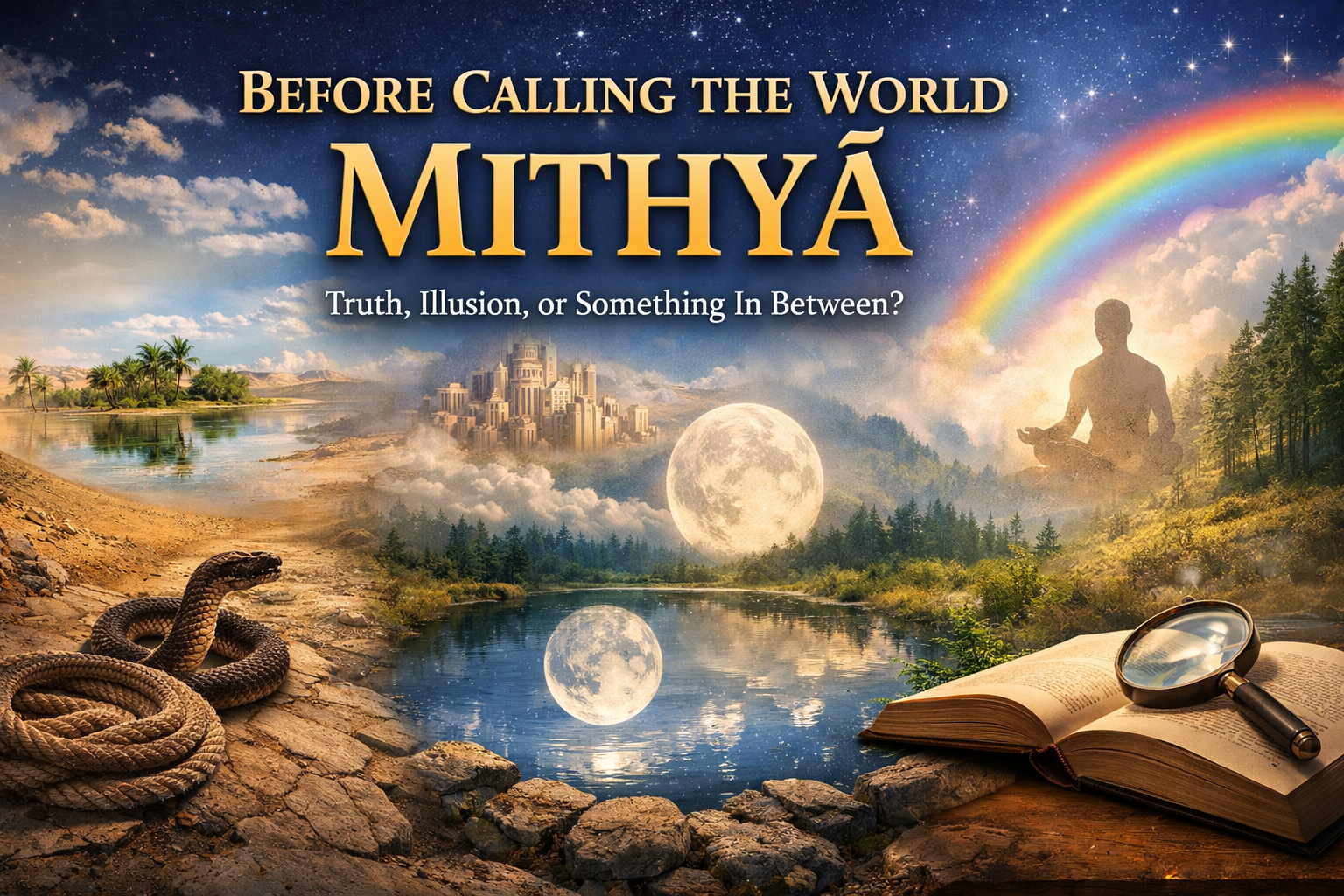
Before Calling the World Mithyā#
Truth, Appearance, Error, and the Discipline of Seeing#
People speak too quickly about truth.
We say, “This is real.” “That is false.” “The world is mithyā.” “Saṃsāra is mithyā.” “Mithyā means illusion.” “Mithyā means untruth.” Sometimes, in reaction, someone says, “No, mithyā itself is a kind of truth.” Such statements sound sharp and memorable. They sound philosophical. But very often they hide confusion rather than remove it.
A barren woman’s son, a snake seen in a rope, water seen in a mirage, the blue sky above us, a rainbow in the distance, a reflection in a pond, a dream city, and the world of daily experience do not all belong to the same class. Yet in casual speech they are often thrown together under words like false, unreal, illusory, or mithyā. That is not a small mistake. It is a serious philosophical carelessness.
To understand mithyā, we must first become careful about truth.
This article does not begin with a slogan. It begins with restraint. Before declaring anything true, false, unreal, or mithyā, we must first ask how truth is known, how error arises, and what stands between appearance and reality. We must be willing to slow down.
That willingness itself is part of philosophical maturity.
Why Quick Statements Mislead#
Human beings do not encounter reality in a naked, direct, effortless way. We encounter it through the senses, through the mind, through memory, through concepts, through expectation, through fear, through desire, through language, through culture, through training, and through ignorance. What we call “knowing” is not a single event. It is a layered process.
Something is there.
Something appears.
Something is perceived.
Something is interpreted.
Something is concluded.
Later, something may be corrected.
Error can enter at any point.
A person says, “I saw it with my own eyes.” But what does that really mean? Was the object clearly visible? Was there enough light? Was only a partial form seen? Was the mind calm, or frightened? Was the observer distracted? Was the thing directly visible at all, or only inferable? Did the observer use the right means of knowledge? Without asking such questions, confidence can easily masquerade as truth.
This is why quick and crispy statements about mithyā are dangerous. They sound profound, but they often flatten very different kinds of cases into one word.
Seeing Is Not Yet Knowing#
We know the world through the jñānendriyas, the organs of knowledge. Among them, sight and hearing dominate much of ordinary life. To understand truth and error, let us take visual experience as the main example.
Even in simple seeing, several layers are involved.
There is what is actually there.
There is what appears to me.
There is what my mind makes of that appearance.
There is what I finally conclude it to be.
These are not always the same.
In dim light, I may not clearly see a rope or a snake. I may see only an elongated curved form. The senses provide something partial. The mind, aided by memory and fear, supplies the rest. Thus what is seen, what is perceived, and what is concluded are not identical.
This distinction is crucial. Much philosophical confusion begins when appearance, perception, and conclusion are treated as one.
Seven Questions Before Calling Anything True#
Before calling anything true, false, illusory, unreal, or mithyā, we should ask seven questions:
- What is actually there?
- What is appearing to me?
- What am I perceiving in that appearance?
- What am I concluding it to be?
- By what means can it be better known?
- What is preventing right knowing?
- Can it ever be fully known as it is, or is there a human limitation?
These questions form a discipline of inquiry. They prevent haste. They force us to distinguish the object from the appearance, the appearance from the interpretation, and the interpretation from the truth.
They also remind us that not every confusion is of the same kind. Some things are impossible. Some are misperceived. Some are genuinely experienced but wrongly understood. Some remain sensorially misleading even after intellectual correction. Some are relational. Some are practical but not ultimate. Some are dependent realities, neither absolutely real nor absolutely unreal.
Only after learning these distinctions can one approach mithyā responsibly.
Different Kinds of “Not-Truth”#
The word “untrue” is too blunt. We need a more careful classification.
Broadly speaking, we can distinguish at least these types:
- impossible non-entities
- mistaken identification
- misleading appearance
- persistent appearance that remains after correction
- observer-dependent phenomena
- dream experience
- practical reality
- dependent reality in the deeper Advaitic sense
Let us move through them patiently.
I. Impossible Non-Entities#
Consider phrases like:
- a barren woman’s son
- a square circle
- a sky-flower
- a married bachelor
These are not sensory mistakes. They are not appearances wrongly interpreted. They are conceptual impossibilities. Nothing corresponding to them can exist as described.
If we apply the seven questions here, the answer is immediately revealing. What is actually there? Nothing of that kind. What is appearing? Usually nothing at all; only words are operating. What is being perceived? At best, a mental construction made from incompatible ideas. What is preventing right knowing? Logical negligence.
This class is important because it must be sharply separated from everything else.
A barren woman’s son is not like a rope seen as a snake. In the first case, there is no possible object. In the second, there is an object, but it is wrongly identified. If we fail to distinguish these, our language becomes lazy.
Therefore, when philosophers say the world is “not absolutely real,” it cannot mean that the world is in the same category as a square circle or a barren woman’s son. That would not be subtle philosophy. That would be conceptual collapse.
II. Mistaken Identification: Rope and Snake#
Now let us take the famous case: a rope seen as a snake.
Here something is present. The error is not total emptiness. There is a real object there. But it is taken to be something else.
What is actually there? A rope.
What is appearing? A dim, elongated form.
What is perceived in that appearance? Something snake-like.
What is concluded? “This is a snake.”
How can it be better known? More light, closer inspection, calm observation, perhaps another observer.
What prevents right knowing? Darkness, fear, haste, memory of snakes.
Can it be fully known? Yes. Once the conditions improve, the rope is seen clearly.
This is a powerful example because it shows how superimposition works. The object is one thing; the mind projects another. Yet even here we must be careful. Rope-snake is a case of error. It is not by itself the whole meaning of mithyā. It reveals one mechanism of confusion, but not every layer of dependent reality.
III. Misleading Appearance: Mirage, Reflection, and Similar Cases#
Some cases are subtler. Something appears, and the appearance is not sheer nothing. Yet what is taken from it is wrong.
Take the mirage in the desert.
Water exists in the world. But not there in that way.
What is actually there? Heated air, desert ground, optical conditions.
What appears? A water-like shimmer.
What is perceived? A lake-like surface.
What is concluded? “There is water there.”
How can it be better known? Approach the spot, understand the optics, learn from experience.
What prevents right knowing? Distance, heat, expectation, unfamiliarity.
Can it be fully known? Yes, but not from a quick glance.
The same is true of the reflection of the moon in a pond. There is something real here: the moon, the water, and the optical relation. Yet if a child says “There is another moon in the pond,” the conclusion is wrong. The appearance is real as appearance. The error lies in the way it is taken.
This class teaches us an important refinement. Not all error is simple misidentification of one object as another. Sometimes a phenomenon appears, but its location, status, or mode of being is misunderstood.
IV. When Knowledge Changes but Appearance Remains#
Now we come to a very important class: appearances that do not vanish simply because one has been corrected intellectually.
The blue sky is a perfect example.
What is actually there? Sunlight scattered by the atmosphere, with dark space beyond.
What appears? A blue expanse overhead.
What is perceived? A blue sky, perhaps almost like a dome.
What is concluded? That the sky itself is blue.
How can it be better known? Through optics, physics, astronomy.
What prevents right knowing? The natural structure of sensory experience and the lack of scientific understanding.
Can it be fully known? Its mechanism can be known. But the appearance remains blue.
The same is true of the apparent rising of the sun. Even after one knows that the Earth rotates, one still speaks of sunrise and sunset. The same is true of the Earth feeling still beneath our feet. The same is true of matter appearing solid though science tells us that at another level it is mostly empty space structured by forces and fields.
These examples teach us that sensory truth and scientific truth are not the same. The senses deliver one order of reality, useful for living. Science often reveals another order, deeper in explanation.
This is not a trivial point. It means human perception was not designed to reveal ultimate reality. It was shaped for action, orientation, and survival.
V. Observer-Dependent Phenomena#
Some things are not fixed objects in the simple ordinary sense. They arise through relation.
The rainbow is a beautiful example.
What is actually there? Sunlight, water droplets, optical law, and the observer’s position.
What appears? A colored arc.
What is perceived? A bow in the sky.
What is concluded? Often, that it is a fixed object “there” waiting to be reached.
How can it be better known? By changing position, comparing viewpoints, understanding optics.
What prevents right knowing? The habit of assuming that every appearance must correspond to a self-standing object.
Can it be fully known? Yes, as a relational phenomenon; not as a solid object located at one fixed point.
This is philosophically important. Reality is not made only of objects. Some realities are relational. They depend on standpoint and condition. They are not false, but neither are they independent in the manner we ordinarily assume.
This insight becomes highly relevant when speaking of mithyā, because dependence does not automatically mean non-existence.
VI. Dream: A Different Order of Experience#
Dream introduces another layer altogether.
In dream, one can walk in cities, speak to friends, run from danger, suffer loss, feel joy, climb mountains, fall into rivers, meet the dead, fear for one’s life, or celebrate victory. While dreaming, the dream-world is experientially real. Emotion is real. Response is real. Fear is real. Relief is real.
Yet upon waking, the status of that world changes.
What is actually there? From the waking standpoint, no external city corresponding to the dream.
What appears? A full dream-world.
What is perceived? Objects, places, relationships, danger, opportunity.
What is concluded? While dreaming, “this is real.”
How can it be better known? Only by waking, or sometimes by lucid awareness within the dream.
What prevents right knowing? The dream-state itself and immersion in its internal coherence.
Can it be fully known? Yes, but only from a different order of consciousness.
Dream is philosophically powerful because it shows that experiential vividness does not guarantee ultimate status. Something can be coherent, emotionally intense, and practically meaningful within one state, and yet later be reclassified from a higher standpoint.
This should immediately make us cautious about using words like “real” and “unreal” too casually.
VII. Practical Reality Must Be Honored#
Now we reach a crucial level: the world of ordinary life.
Food nourishes. Fire burns. Debt matters. Promises matter. Relationships shape lives. Law has consequences. Hunger hurts. Grief wounds. Compassion heals. Work sustains a family. A car can injure. Medicine can save a life. None of this is trivial.
If someone says “the world is mithyā” and means by that that suffering is fake, ethics are irrelevant, and relationships do not matter, that person has not understood anything subtle. That is not wisdom. That is crudity dressed as philosophy.
Practical reality has validity. It operates. It matters. It is the field in which dharma, adharma, duty, consequence, attachment, loss, and love all arise.
Take grief after the death of someone deeply loved. That is not like seeing a snake in a rope. The event is not a mere sensory mistake. The sorrow is not a trivial illusion. And yet a deeper philosophical inquiry may still ask whether the person, the body, and the empirical identity were ultimate and self-standing. This is precisely why the discussion of mithyā requires maturity. It must neither flatten practical life nor absolutize it.
Practical truth is real within its sphere. It cannot be casually dismissed.
VIII. Five Layers of Truth#
At this stage, a useful distinction emerges: sensory truth, mental truth, practical truth, scientific truth, and ultimate truth.
Sensory truth#
This is what appears to the senses. The sky looks blue. Fire feels hot. The floor feels still. The bell sounds loud.
Mental truth#
This is what the mind makes of what appears. “This is dangerous.” “That man hates me.” “I am a failure.” “This shape is a snake.” The mind interprets, projects, remembers, fears, and concludes.
Practical truth#
This is what works in ordinary life. Sunrise for timekeeping. Money for transaction. A table as a support. Social roles for functioning. The map need not capture the deepest ontology to remain practically useful.
Scientific truth#
This is the truth of mechanism, explanation, measurement, and theory. The sky appears blue because of scattering. The Earth rotates. Matter has structure beyond immediate perception. Disease may arise from microbes not visible to the naked eye.
Ultimate truth#
This is that which does not depend on shifting standpoints, unstable appearances, or relative practical convenience. In Advaita, this is the space in which Brahman is discussed.
Confusion begins whenever one layer is mistaken for another. Sensory appearance is taken as final reality. Mental reaction is taken as fact. Practical convenience is mistaken for ultimate explanation. Scientific explanation is mistaken for metaphysical completeness. A philosophical slogan is mistaken for realization.
The word mithyā becomes meaningful only when these layers are not mixed carelessly.
IX. What Prevents Right Knowing?#
Human error has many sources.
The state of consciousness matters. Dream, waking, distraction, fear, meditation, fatigue, intoxication, grief, all shape experience.
The senses have limits. They cannot see all scales, hear all frequencies, or penetrate every condition.
The environment matters. Darkness, fog, reflection, heat, distance, echo, and unfamiliar terrain all affect appearance.
The object itself matters. Some things are transparent, subtle, hidden, relational, microscopic, or conceptually difficult.
Memory and prior knowledge matter. We interpret the present through the past.
Emotion matters. Fear sees danger quickly. Desire beautifies. Anger exaggerates insult. Grief darkens the world.
Conceptual equipment matters. If there is no concept available, some truths cannot even be framed.
Historical knowledge matters. Humanity itself learns gradually. Some truths become available only through civilizational development.
And above all, the right means of knowledge matters. Every truth is not known by the same instrument. We do not use the ear to know color, nor a microscope to know justice, nor a telescope to know the Self.
This last point is decisive. The means of knowledge must fit the kind of truth being sought.
X. So What Is Mithyā Not?#
By now some things should be clear.
Mithyā is not absolute non-existence like a square circle.
It is not merely a perceptual mistake like rope-snake.
It is not just “fake.”
It is not practical uselessness.
It is not sheer hallucination.
And it is not absolute, self-standing reality either.
Something can appear, function, matter, and yet not possess independent ultimate status.
That is the doorway to a more careful understanding.
XI. A More Responsible Approach to Mithyā#
A helpful formulation is this:
Something is mithyā when it is neither absolutely unreal nor absolutely self-standing. It appears. It is experienced. It functions. It has practical validity. Yet it does not exist independently. It depends on a substratum, a standpoint, a condition, or a higher order of reality.
This is why classical examples like pot-clay, ornament-gold, and wave-water matter. The pot is not nothing. It can hold water. It can be bought and sold. It can break. Yet it does not stand apart from clay. The ornament shines, delights, and has value. Yet as substance it is gold. The wave rises and falls, yet it is never independent of water.
In that sense, mithyā is subtler than “illusion.” Illusion, in modern casual English, often suggests outright falsity. But mithyā points toward dependent reality: experienced, functional, meaningful, but not ultimately independent.
This is why translating mithyā simply as “illusion” often misleads.
XII. Is Saṃsāra Mithyā?#
Now the famous statement can be revisited.
If someone says “saṃsāra is mithyā,” it should not mean that the world is useless, fake, or identical to a barren woman’s son. It should not mean that suffering is irrelevant or ethics unnecessary.
Rather, it can mean that the world of change, relation, identity, gain, loss, birth, death, and transaction is not absolute and self-standing. It appears. It functions. It binds when absolutized. It is real enough for practical life, moral responsibility, learning, suffering, and liberation. Yet from the deepest standpoint it is dependent, not independent.
This is a serious claim. It cannot be handled by slogan. It requires philosophical discipline and existential maturity.
XIII. A More Careful Language#
Instead of saying too quickly:
- “Mithyā means illusion.”
- “The world is unreal.”
- “Everything is false.”
- “Nothing matters.”
one may speak more responsibly:
- Not everything that appears has the same order of reality.
- Some things are impossible, some misperceived, some relational, some practical, some dependent.
- The world is not absolute in the Advaitic sense, yet it is not sheer nothingness.
- Mithyā indicates dependent reality, not simple non-existence.
- The error lies in taking the dependent as independent, the relative as absolute.
This language is slower, but truer.
XIV. Before the Word, the Discipline#
The deepest lesson is simple.
Before using a profound word, become worthy of it.
Do not rush to call something true because it is vivid.
Do not rush to call something false because it is corrected.
Do not rush to call something unreal because it is dependent.
Do not rush to call something mithyā because the phrase sounds philosophical.
First ask:
What is actually there?
What is appearing?
What am I perceiving?
What am I concluding?
By what means can it be better known?
What blocks right knowing?
Can it ever be fully known as it is?
These questions do not weaken truth. They protect it.
Conclusion#
The word mithyā should not be used as a convenient basket for everything that is not absolutely real. Between absolute truth and absolute non-existence lies a vast territory: error, relation, appearance, perception, dream, practical life, scientific correction, and dependent reality.
A barren woman’s son is not the same as a rope-snake. Rope-snake is not the same as mirage. Mirage is not the same as blue sky. Blue sky is not the same as rainbow. Rainbow is not the same as dream. Dream is not the same as grief, love, duty, hunger, law, or moral consequence. And none of these, by itself, exhausts the meaning of mithyā.
Therefore the first task is not to repeat a doctrine. It is to cultivate discrimination.
Only a mind that has learned to distinguish these layers can approach the phrase “saṃsāra is mithyā” with seriousness. Then the statement is no longer a slogan. It becomes an invitation to inquire into dependent reality, human limitation, and the deeper ground upon which all appearance rests.
Truth is not honored by haste. It is honored by disciplined seeing.
Hari Om Tat Sat
Yours Truly Hari

Comments: