
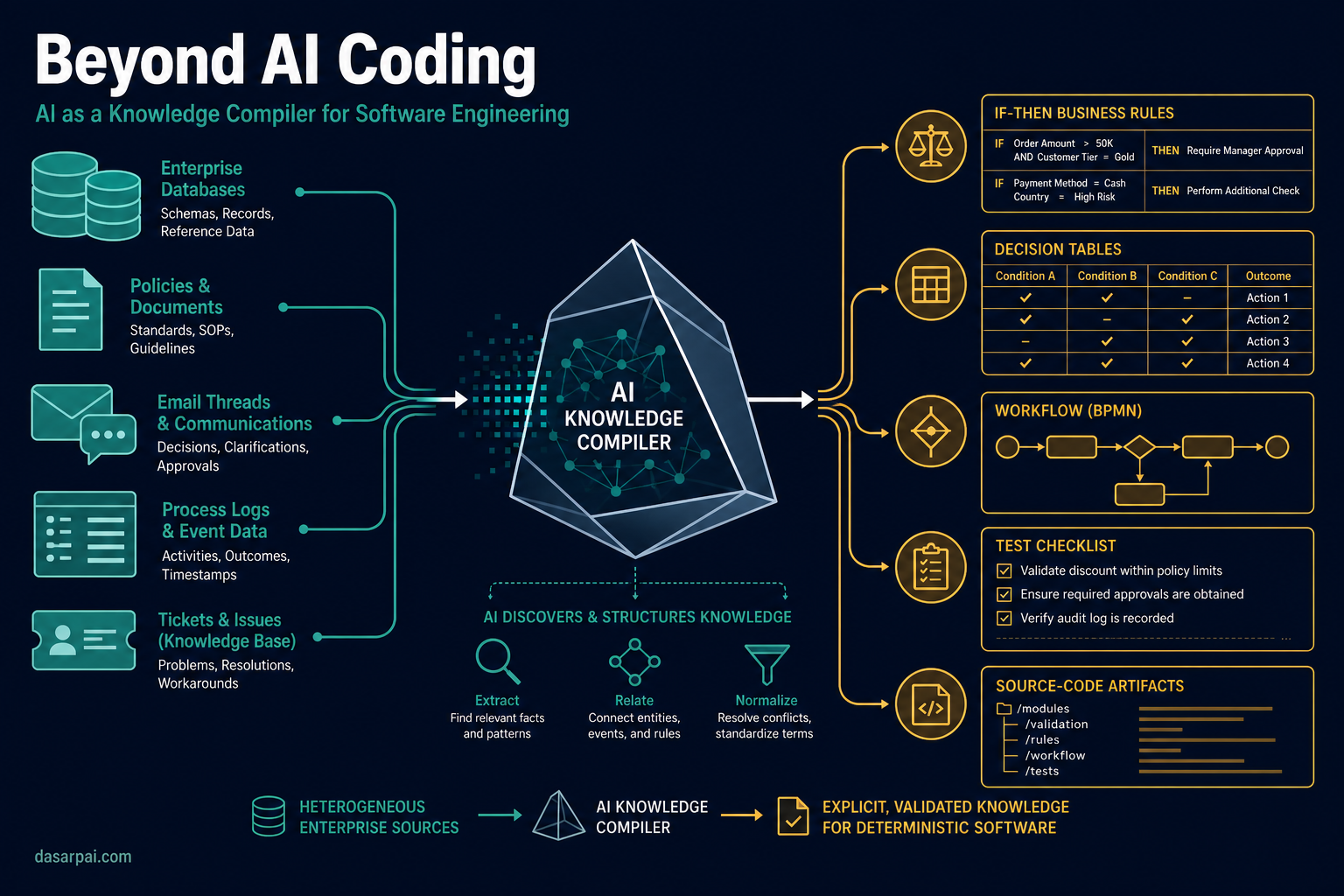
Beyond AI Coding: How AI is Becoming a Knowledge Compiler for Software Engineering#
For the last few years, the software industry has been discussing Artificial Intelligence from two perspectives.
The first is building software that uses AI. Chatbots, recommendation engines, fraud detection systems, document understanding platforms, autonomous agents, and countless other applications rely on machine learning or large language models to perform work during production.
The second is using AI to build software. Tools such as ChatGPT, Claude Code, GitHub Copilot, Cursor, Windsurf, and many others help developers write code, generate tests, explain APIs, review pull requests, and accelerate software development.
These are undoubtedly transformative.
However, there is a third use of AI that receives far less attention but may ultimately have an even greater impact on enterprise software engineering.
Instead of using AI to run software or write software, we can use AI to discover the knowledge that software should implement.
This is a fundamentally different role.
The Traditional Software Development Process#
Consider how enterprise software has traditionally been built.
A customer describes a business process.
Business Analysts conduct interviews.
They organize workshops.
They read documents.
They analyze historical reports.
They study databases.
They ask hundreds of questions.
Eventually they produce artifacts such as:
- Business requirements
- Process flows
- Decision tables
- Validation rules
- Exception handling rules
- Functional specifications
Developers then translate these artifacts into source code.
In other words,
Business Knowledge
        ↓
Business Analyst
        ↓
Requirements
        ↓
Developer
        ↓
Software
The Business Analyst acts as a translator between organizational knowledge and software.
Where Does This Knowledge Come From?#
An organization rarely knows all of its own rules explicitly.
The real business logic is scattered across many places.
Some knowledge exists in policy documents.
Some exists inside databases.
Some exists inside email conversations.
Some exists inside ticketing systems.
Some exists in audit reports.
Some exists only in the minds of experienced employees.
Some exists simply because people have repeatedly handled similar situations over many years.
The organization itself becomes the knowledge base.
Unfortunately, much of this knowledge is never documented.
AI Changes the First Step#
Large Language Models have demonstrated an unexpected capability.
They are remarkably good at reading large collections of heterogeneous information and identifying patterns.
Instead of interviewing twenty operations managers, AI can analyze:
- Transaction history
- Process logs
- Historical decisions
- Exception comments
- Emails
- Policies
- SOP documents
- Knowledge bases
- Audit findings
- Support tickets
From this information, AI can infer candidate business rules.
For example,
When settlement date differs by less than two days,
and the counterparty belongs to Group A,
operations consistently classify the exception as Timing Break.
Or
Invoices from Vendor X exceeding ₹50,000
always require two levels of approval.
These rules may never have been formally documented.
Yet they exist because the organization has consistently behaved that way.
AI uncovers this hidden organizational knowledge.
This Is Not Machine Learning#
At first glance, this may appear similar to machine learning.
It is not.
Machine learning converts historical data into a mathematical model.
Data
    ↓
Training
    ↓
Model
    ↓
Prediction
The knowledge is encoded inside parameters.
Those parameters may be:
- coefficients
- decision trees
- support vectors
- probability distributions
- embeddings
- neural network weights
Different algorithms represent knowledge differently, but they all produce a model.
Rule Discovery Produces Something Else#
AI-assisted rule discovery produces an entirely different artifact.
Data
    ↓
Pattern Discovery
    ↓
Candidate Rules
    ↓
Human Validation
    ↓
Executable Business Rules
The output is not a predictive model.
The output is explicit organizational knowledge.
For example,
IF Customer_Type = Premium
AND Outstanding_Balance < ₹5,000
THEN Skip Manual Review
Or
IF Trade_Date differs by one day
AND Broker = ABC
THEN Auto-Reconcile
These are understandable.
Auditable.
Explainable.
Version controlled.
Governed.
Developers can directly convert them into software.
The Final Product Is Deterministic Software#
This distinction is important.
The production system may not use AI at all.
Instead, AI participates only during software development.
The deployed software remains deterministic.
It contains explicit rules rather than probabilistic predictions.
This is particularly attractive for industries such as:
- Banking
- Financial Services
- Insurance
- Healthcare
- Taxation
- Government
- Manufacturing
- Compliance
- Regulatory Reporting
where explainability and auditing are often mandatory.
AI Becomes a Knowledge Compiler#
Perhaps the best way to understand this evolution is through a compiler analogy.
A programming compiler transforms human-readable source code into executable machine instructions.
Similarly,
AI can transform organizational knowledge into executable software artifacts.
The input is no longer source code.
The input becomes:
- databases
- documents
- process logs
- historical decisions
- human behavior
- operational patterns
The output becomes:
- business rules
- decision tables
- workflows
- validation logic
- test cases
- API specifications
- database constraints
- source code
AI acts as a Knowledge Compiler.
It compiles enterprise knowledge into engineering artifacts.
The Emerging Software Engineering Pipeline#
The traditional pipeline becomes:
Business Knowledge
        ↓
Business Analyst
        ↓
Requirements
        ↓
Developer
        ↓
Software
The emerging pipeline becomes:
Enterprise Data
        ↓
AI Knowledge Discovery
        ↓
Candidate Business Rules
        ↓
Human Review and Governance
        ↓
Engineering Artifacts
        ↓
AI-assisted Code Generation
        ↓
Software
Notice that AI now contributes long before any source code is written.
Business Analysts Do Not Disappear#
This does not eliminate Business Analysts.
Their role evolves.
Instead of manually discovering every rule, they become:
- knowledge curators
- rule validators
- domain experts
- governance owners
AI may propose hundreds of candidate rules.
Humans determine:
- Is the rule correct?
- Is it legally compliant?
- Is it obsolete?
- Is it specific to one customer?
- Is it accidental rather than intentional?
- Should it become part of the software?
Human judgment remains essential.
A Practical Example#
Imagine building reconciliation software for an investment bank.
Historically, analysts spend months interviewing operations teams.
Instead, AI analyzes:
- millions of reconciliation records
- operator comments
- exception histories
- settlement outcomes
- email discussions
- operational manuals
It discovers that a relatively small set of business rules explains most historical decisions.
Those rules are reviewed by domain experts.
Once approved, another AI system generates:
- BPMN workflows
- decision tables
- validation rules
- automated tests
- production-ready source code
The resulting application is deterministic, auditable, and maintainable.
AI was used to discover knowledge—not to make runtime decisions.
A New Category of AI in Software Engineering#
Today, we usually classify AI into two roles.
AI in Software
AI performs work while the application is running.
AI for Software
AI helps engineers write software.
A third category is now emerging.
AI Before Software
AI studies enterprise knowledge before software exists.
It discovers business logic.
Extracts organizational knowledge.
Generates engineering artifacts.
Only then is software created.
This shift may prove to be one of the most important applications of Artificial Intelligence in enterprise software development.
Looking Ahead#
Every organization possesses decades of accumulated operational knowledge.
Most of it is hidden inside data, documents, systems, and human decisions.
For decades, software engineering depended on people to extract that knowledge manually.
Artificial Intelligence introduces a new possibility.
Instead of programming software directly, we first ask AI to understand how the organization works.
Only then do we build software that faithfully represents that understanding.
The future of software engineering may therefore be described not simply as AI writing code, but as AI discovering knowledge and compiling it into software.
That represents a much deeper transformation than code generation alone.
Hashtags#
#ArtificialIntelligence #SoftwareEngineering #EnterpriseAI #KnowledgeManagement #BusinessRules #AIGovernance #FutureOfSoftware #SoftwareArchitecture #DigitalTransformation #AIForBusiness

Comments: